 AED 150
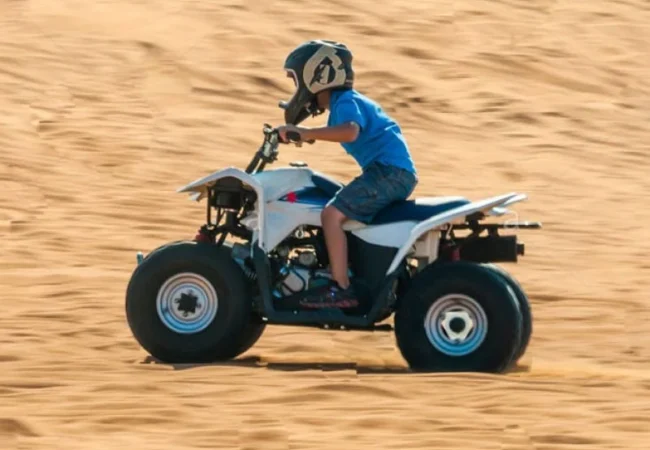
Yamaha 90cc — kids
- Ages 9–12
- Supervised
- Own track
Its own closed loop, kept apart from the main dune route, with a guardian at the fence for the whole session. Speed stays capped and nobody is ever out of sight.
Book this quad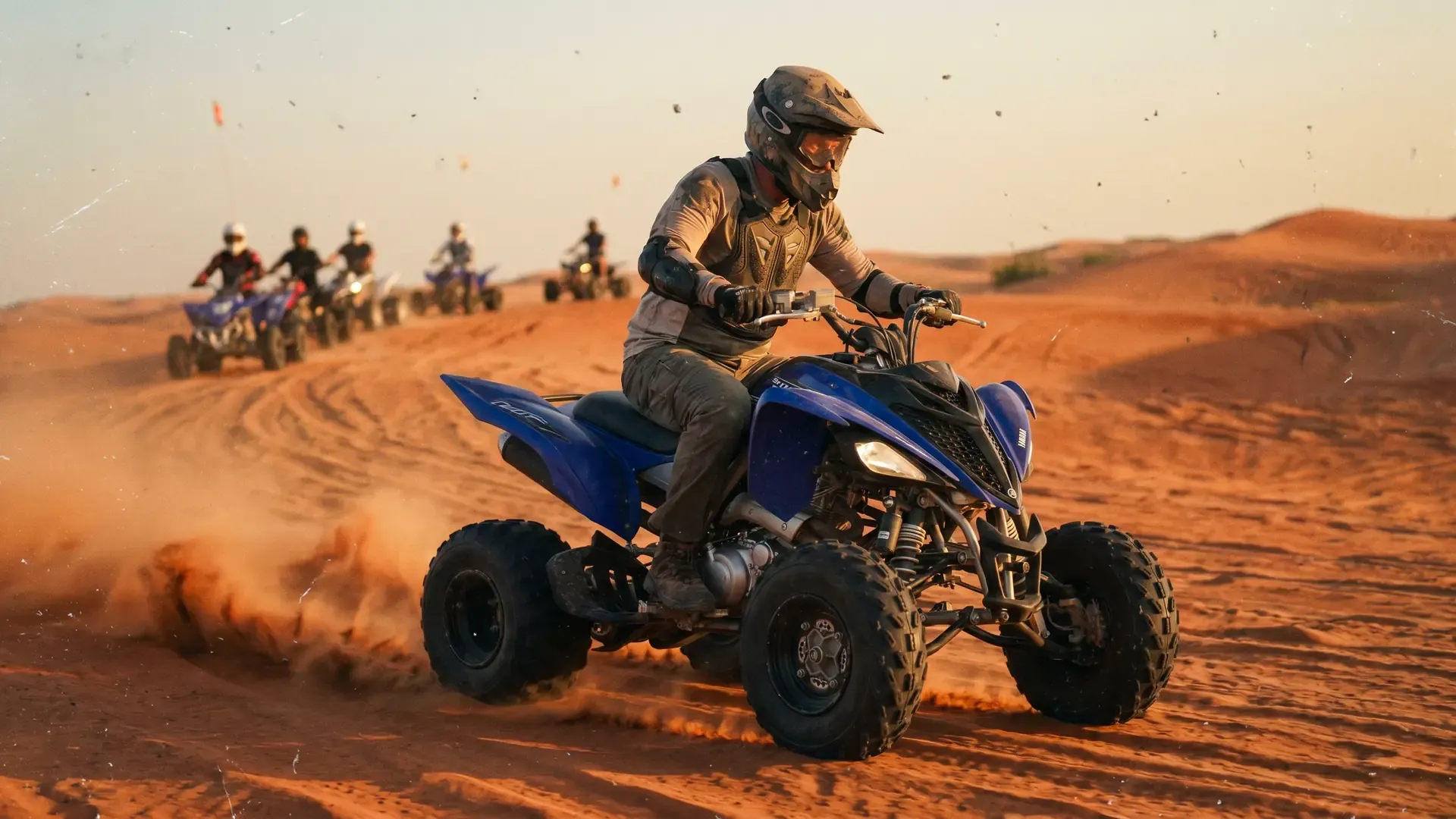
Every outing follows a line through the dunes the lead guide sets that morning, not a groove worn flat by a hundred groups before you. The throttle is yours alone for the session, and the rider ahead of you reads the sand before deciding which ridge gets climbed first. Fleet runs eight deep, starting with a supervised 90cc for children and topping out at the Raptor 700cc.
A Dubai quad tour plays out on the red dunes at Al Lahbab, a good 45 minutes clear of Downtown down the Al Ain road, where the line the group actually rides gets picked fresh each session rather than repeated day after day. AED 200 is the opening adult rate, on the Yamaha 220cc; AED 795 sits at the top, on the Raptor 700cc; and the machine most riders actually choose is the 400cc, priced at AED 250. Children between nine and twelve ride a 90cc on its own supervised loop for AED 150. Everyone riding gets a helmet, chilled water, a safety briefing, and a lead guide out front setting the direction.
Every machine on this list is quoted per rider, one person to one bike. The 400cc double breaks that pattern on purpose, seating two riders for a single combined fee. Nothing gets charged until the machine, timing and pickup are all settled on WhatsApp.
| Machine | Who it is for | From |
|---|---|---|
| Yamaha 90cc | Children 9 to 12, supervised track, guardian present. | AED 150 |
| Yamaha 220cc | First adult quad. Forgiving throttle, easy to place on a slope. | AED 200 |
| Yamaha 400cc | The one most people end up on. Enough power to climb without drama. | AED 250 |
| Yamaha 400cc double | Two-up seat, one fee. For a pair who do not both want to ride. | AED 350 |
| Yamaha 400cc turbo | Same frame, more shove out of a bowl. | AED 350 |
| Yamaha Grizzly 450cc | Heavier utility frame. Better over rough ground and longer routes. | AED 450 |
| Sports quad 625cc | Lighter and sharper. For riders who already ride. | AED 700 |
| Yamaha Raptor 700cc | Top of the range. Screened before handover. | AED 795 |
The list runs by engine size, but that is not where to start. Work out whether you have used a throttle before, then let the machine follow from that. Every guide still leads the group across the same stretch of dunes; what changes with the machine is how much of it you are given.
AED 150Its own closed loop, kept apart from the main dune route, with a guardian at the fence for the whole session. Speed stays capped and nobody is ever out of sight.
Book this quad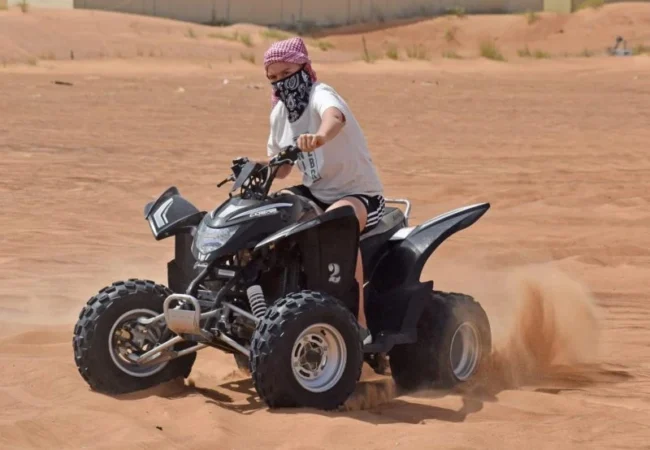 AED 200
Built for the very first ride of your life. Nothing about it happens faster than you can process, and a bad line is easy to fix before it turns into a problem.
Book this quad AED 250
Sits in the middle of the fleet and it is what most guides steer new bookings toward. Enough pull to clear a soft face without needing textbook technique.
Book this quad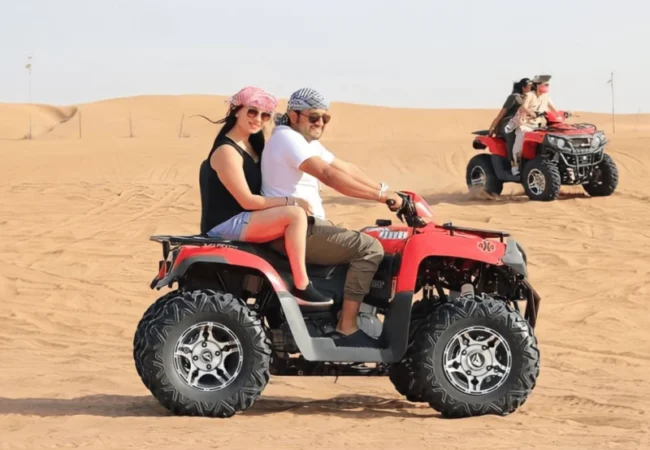 AED 350
One frame, two seats, built for exactly one scenario: someone who wants the throttle, paired with a passenger happy just to hang on for the climb.
Book this quadAED 350What riders ask for on a second visit, once the standard 400 starts to feel familiar. Same feel in your hands, a firmer shove out of every bowl.
Book this quad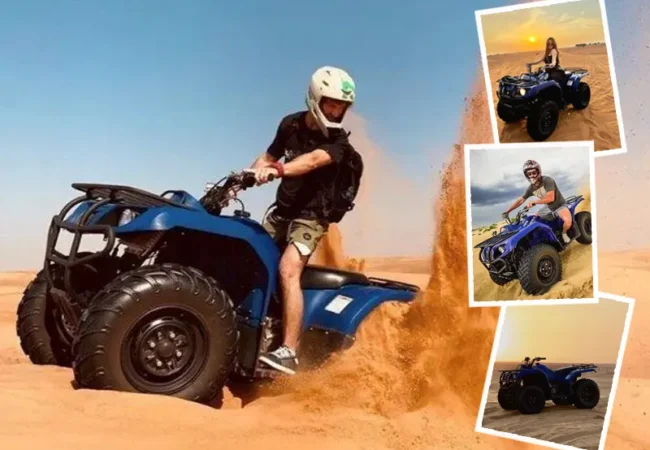 AED 450
Built for load-bearing work, not for racing. It sits lower over broken ground, which starts to matter once your route runs past the standard loop.
Book this quad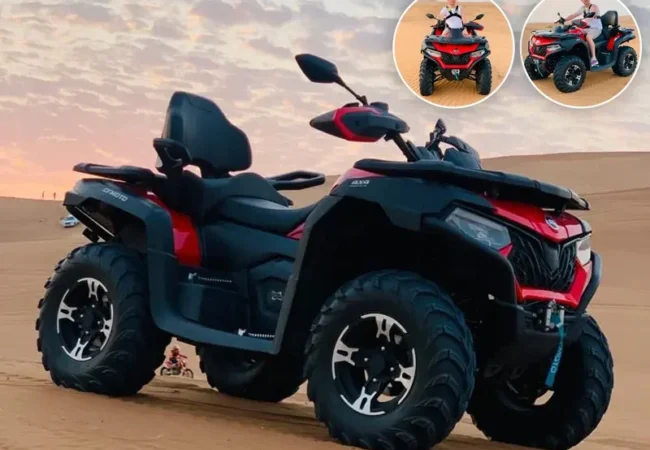 AED 700
Steering that answers instantly and very little patience for a rider leaning back instead of forward. Rewarding if you already ride, tiring if you are still guessing.
Book this quad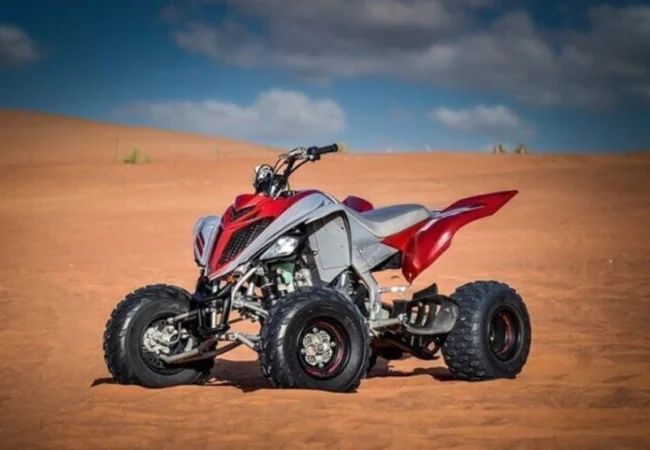 AED 795
Fastest machine on the fleet. Before it is handed over, the guide asks a few pointed questions about your riding history — answer them straight.
Book this quadThese bolt a Land Cruiser safari onto your quad session, add dinner at the camp, or bring in both at once. They are why most groups end up staying out here for the evening instead of heading back after one ride.
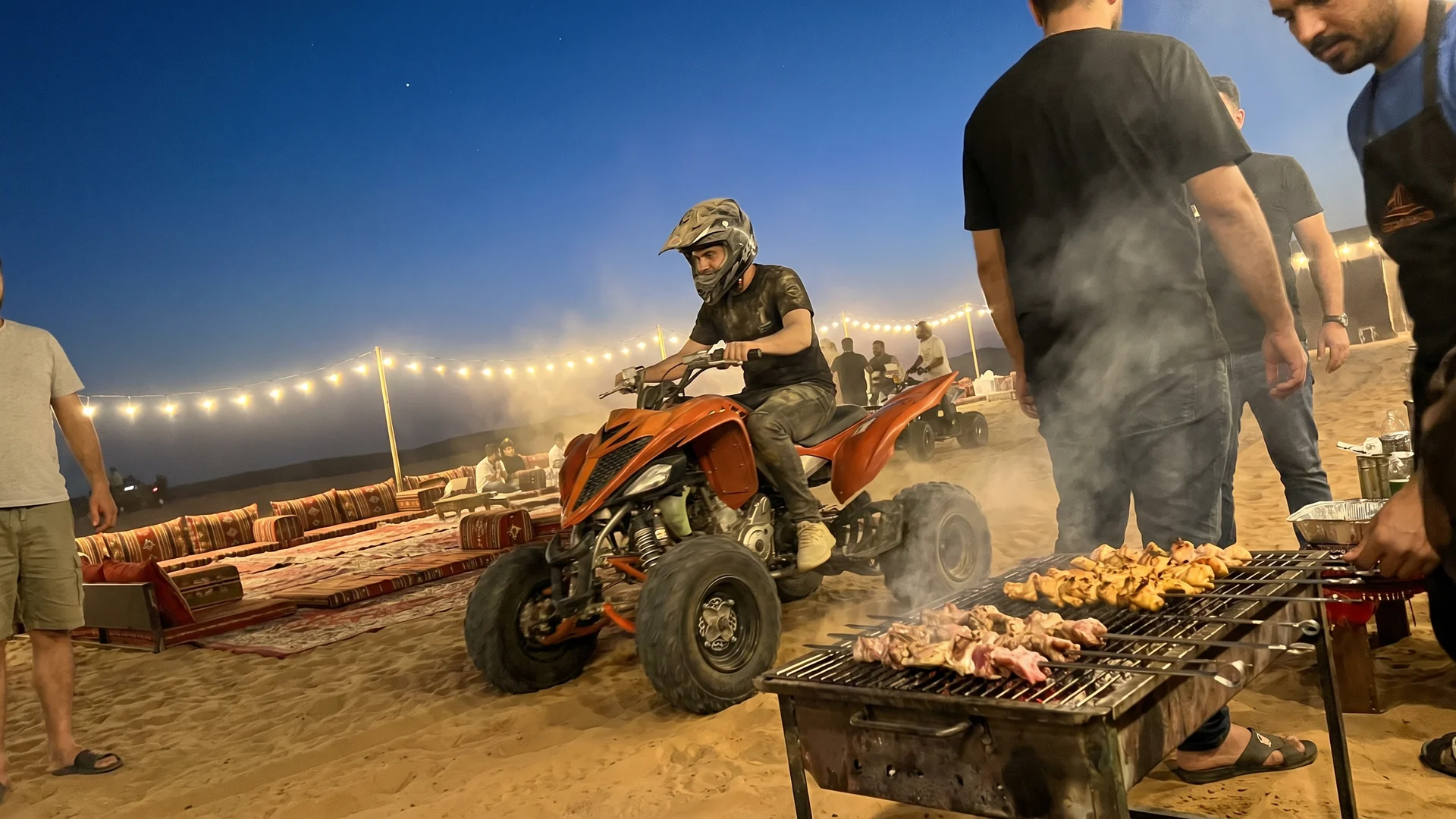 AED 375
A Land Cruiser dune-bashing leg, a quad session under your own control, then sunset and the halal BBQ camp. More people book this exact combination than anything else on the site.
Book this combo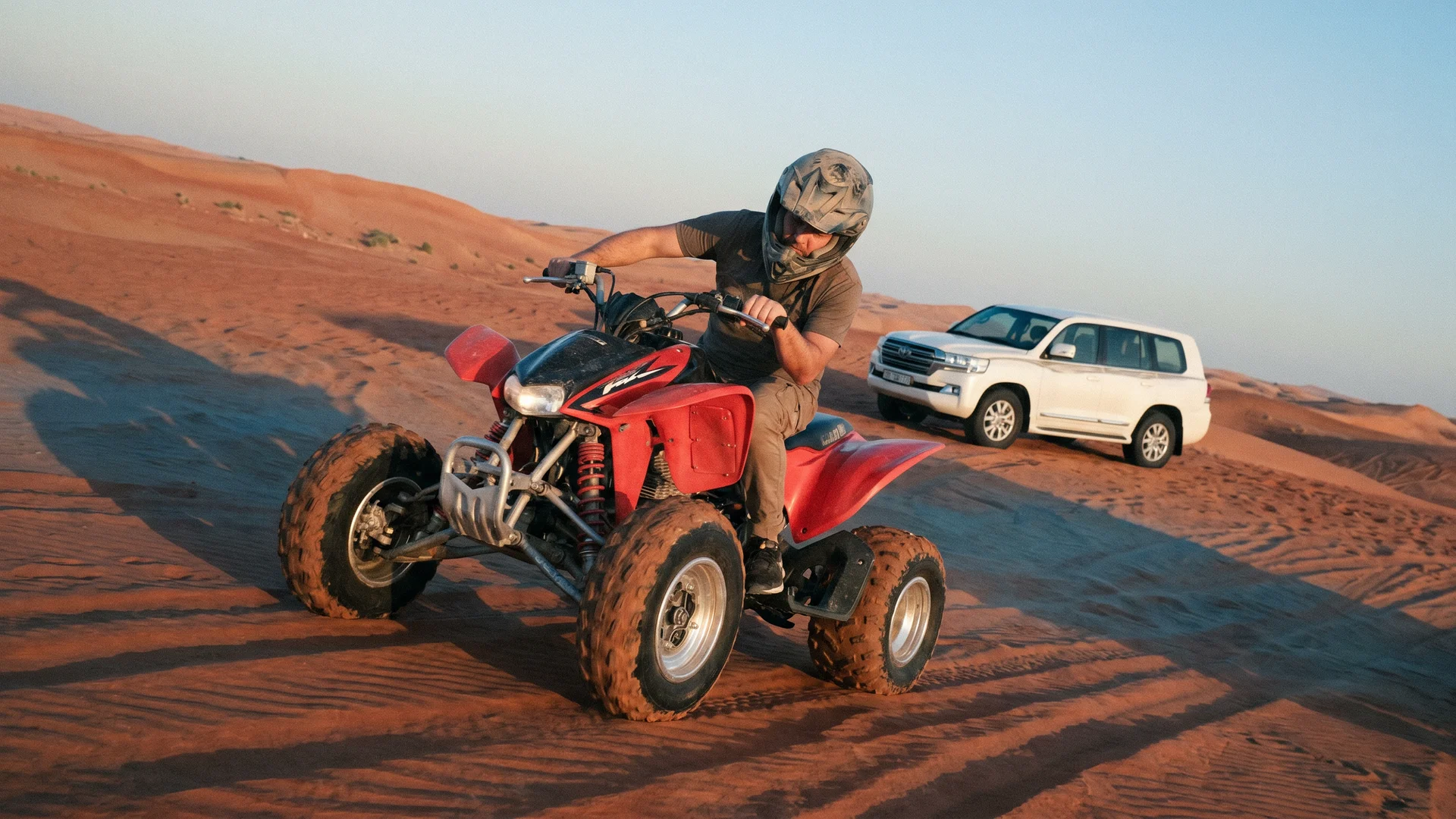 AED 290
The overnight sand is still firm, the dunes are quieter, and the whole thing wraps before the day heats up. The smart booking once summer arrives.
Book this combo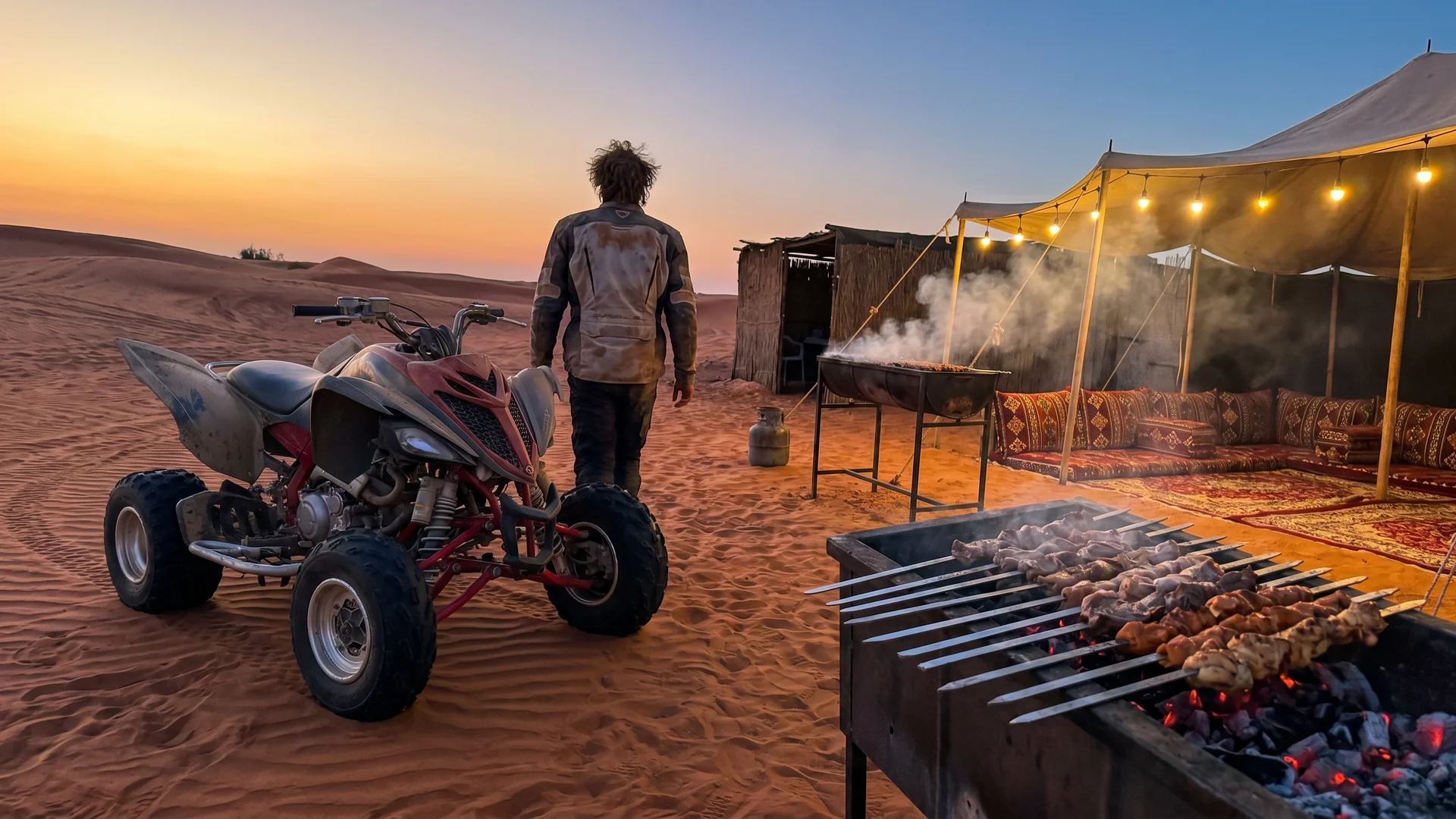 AED 700–1,300
Riding and dinner, with the 4x4 dune-bashing leg left out. The machine you pick swings the price, not what ends up on the plate.
Book this combo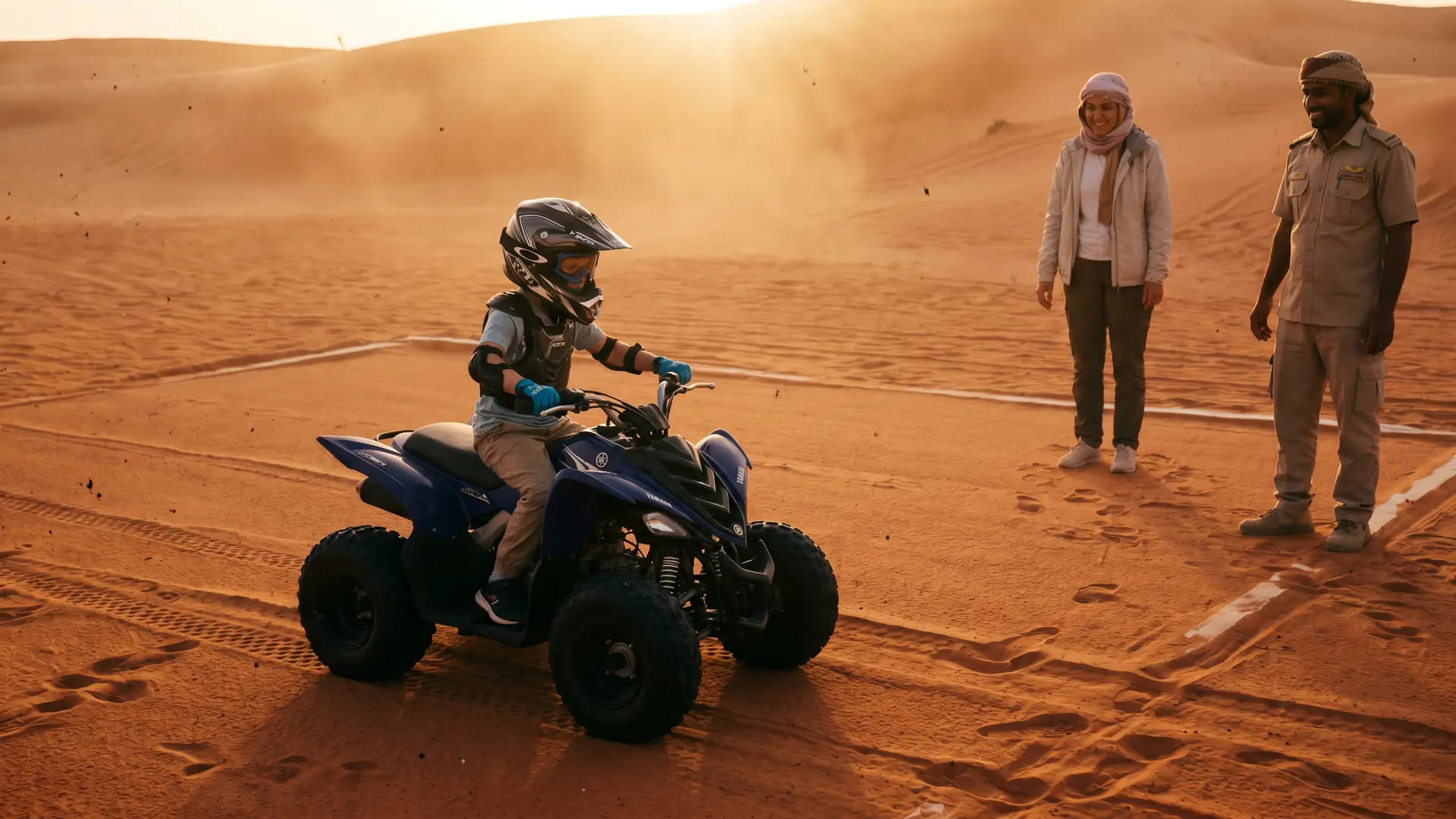 AED 150
Children work the 90cc loop while the adults take the wider route. Everyone gets a machine, and nobody spends the hour waiting in a car park.
Book a family sessionNot a car — think motorcycle, jet ski, snowmobile, anything steered as much by leaning as by turning a wheel.
Mixed groups are the default here, not a special case the guides work around.
Where a quad leaves you exposed to the elements, a buggy wraps the same idea in a roll cage, straps you into a harness, and hands you a wheel and pedals instead of bars, with space for passengers riding along. Plenty of groups run both machines across one visit.
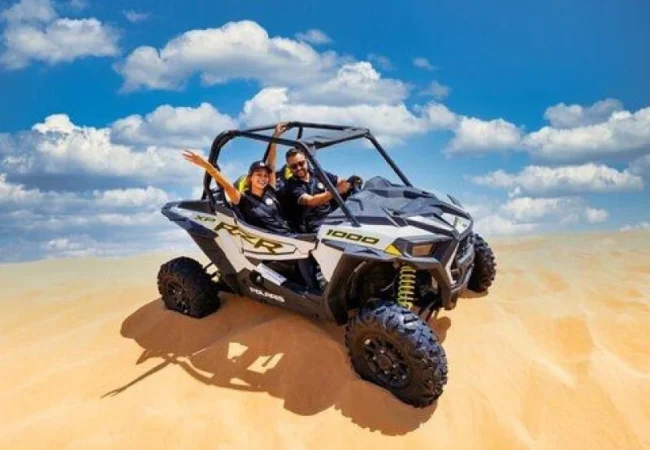
The entry point into the buggy fleet. Predictable to drive and forgiving the first time you misjudge a line.
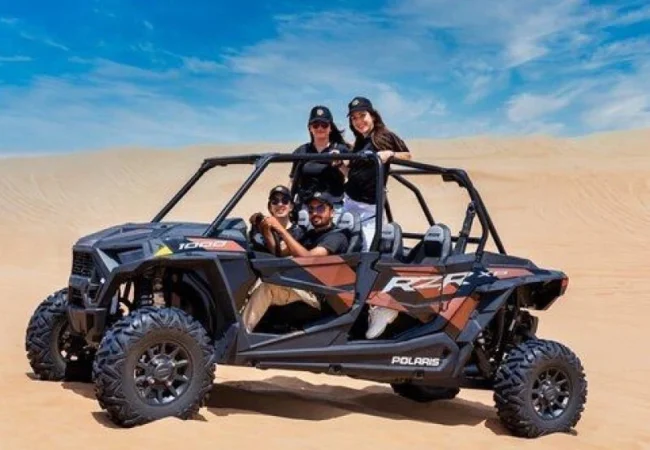
One driver, four harnesses, one invoice — nothing on the list beats it per head for moving a full group onto the dunes.
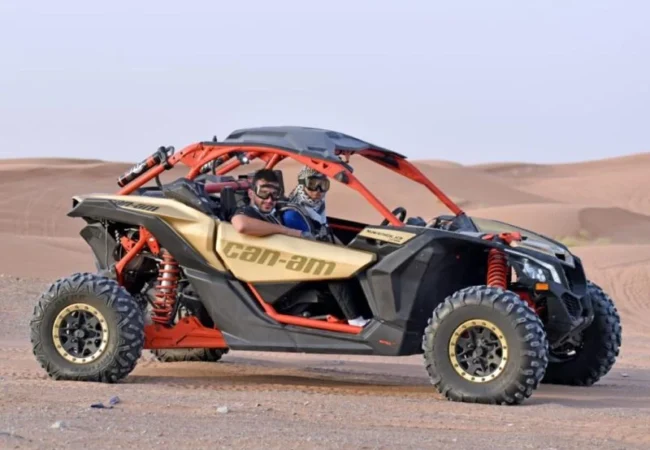
A wider stance and longer suspension travel that soak up rough ground far better than the standard buggy.
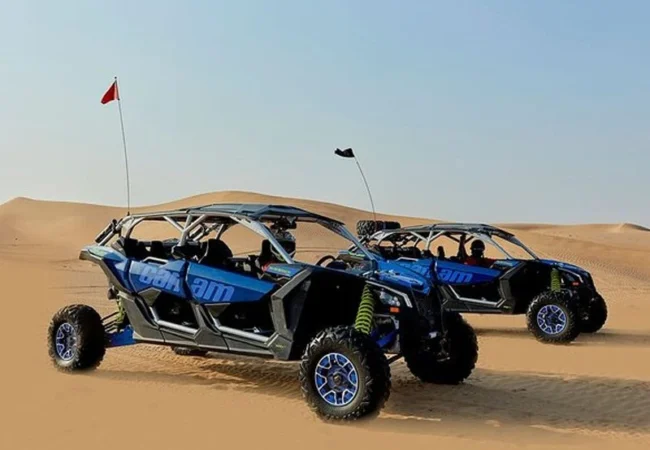
200hp and four harnesses, built for a driver who wants real speed with passengers still on board.
This is the one activity on the site with a screening call before anyone confirms a booking. On sand, two wheels expose bad technique in a way four wheels simply mask, and a KTM will not paper over the gaps the way a quad's extra footprint can.
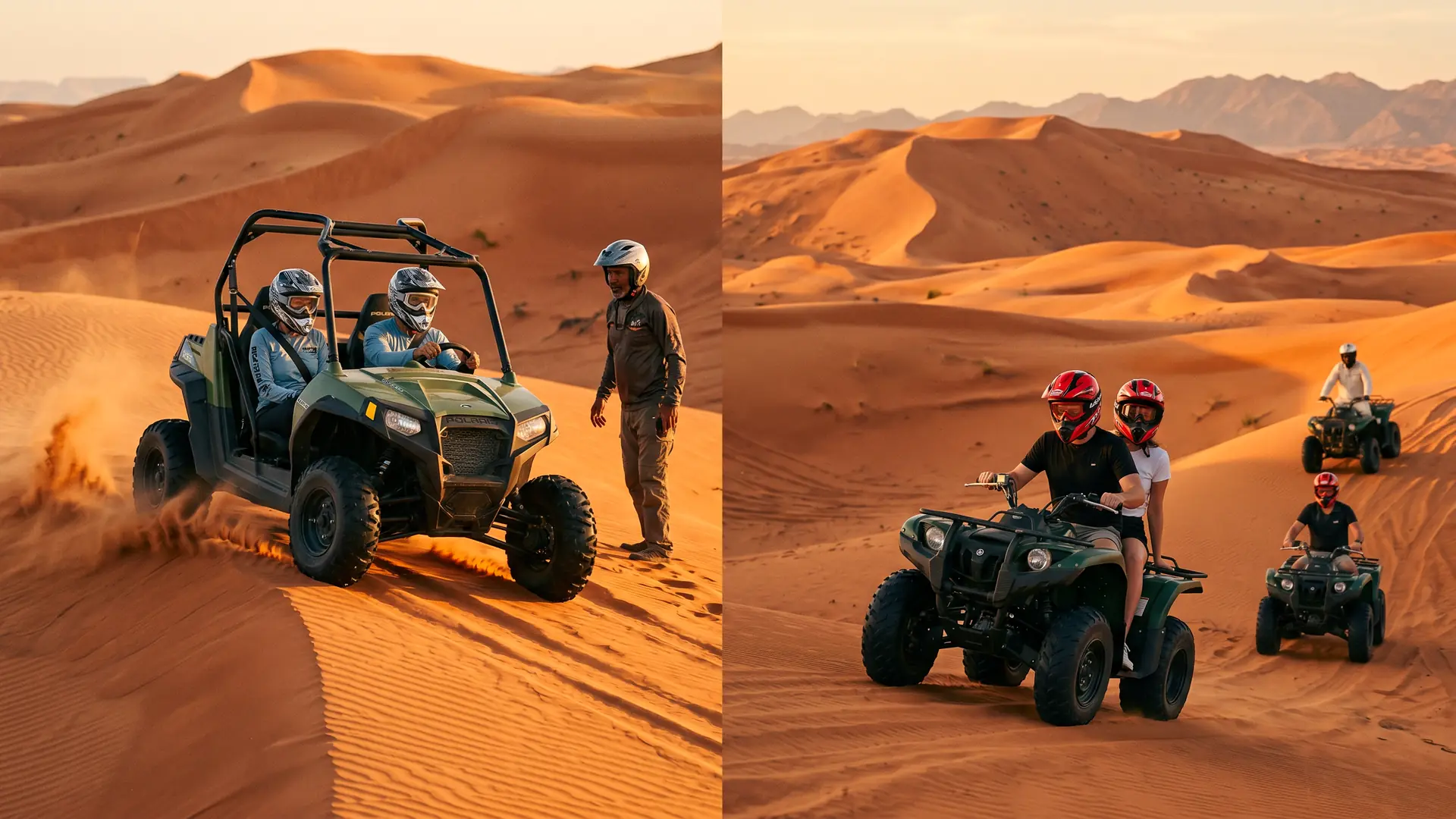
The hourly rate sits at AED 850, with two hours available for AED 1,250. Genuine off-road riding hours are expected before you book.
A no from the screening call is not the end of the story — the Raptor 700cc still matches most of that pace, just with two more wheels underneath you.
AED 225 gets you into a Land Cruiser desert safari, worth a look even if a quad is what brought you here, since most groups have at least one person who would rather sit back than steer anything themselves.
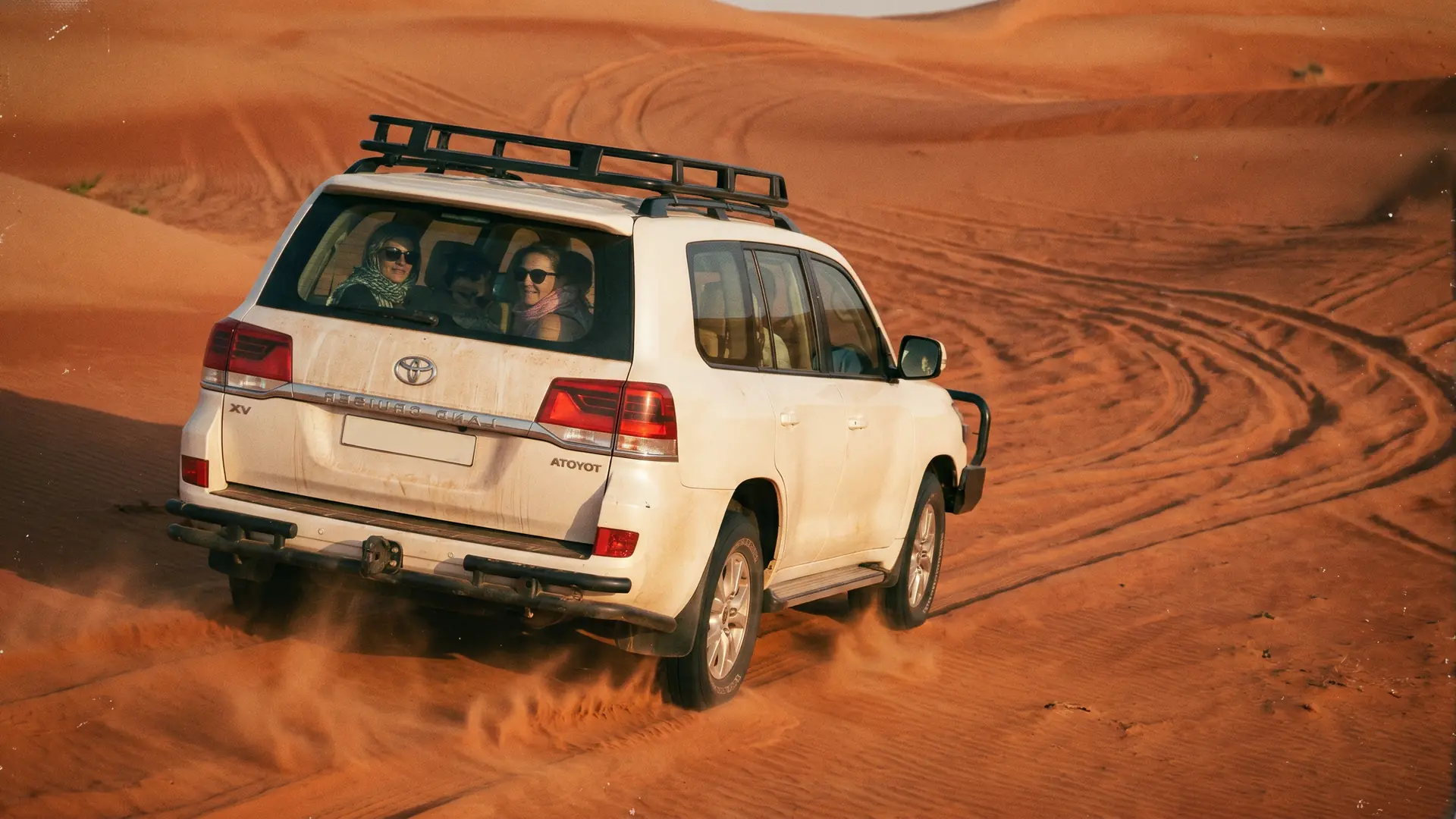
An early start on sand that is still cool from the night, and you are free again well before lunch plans start.
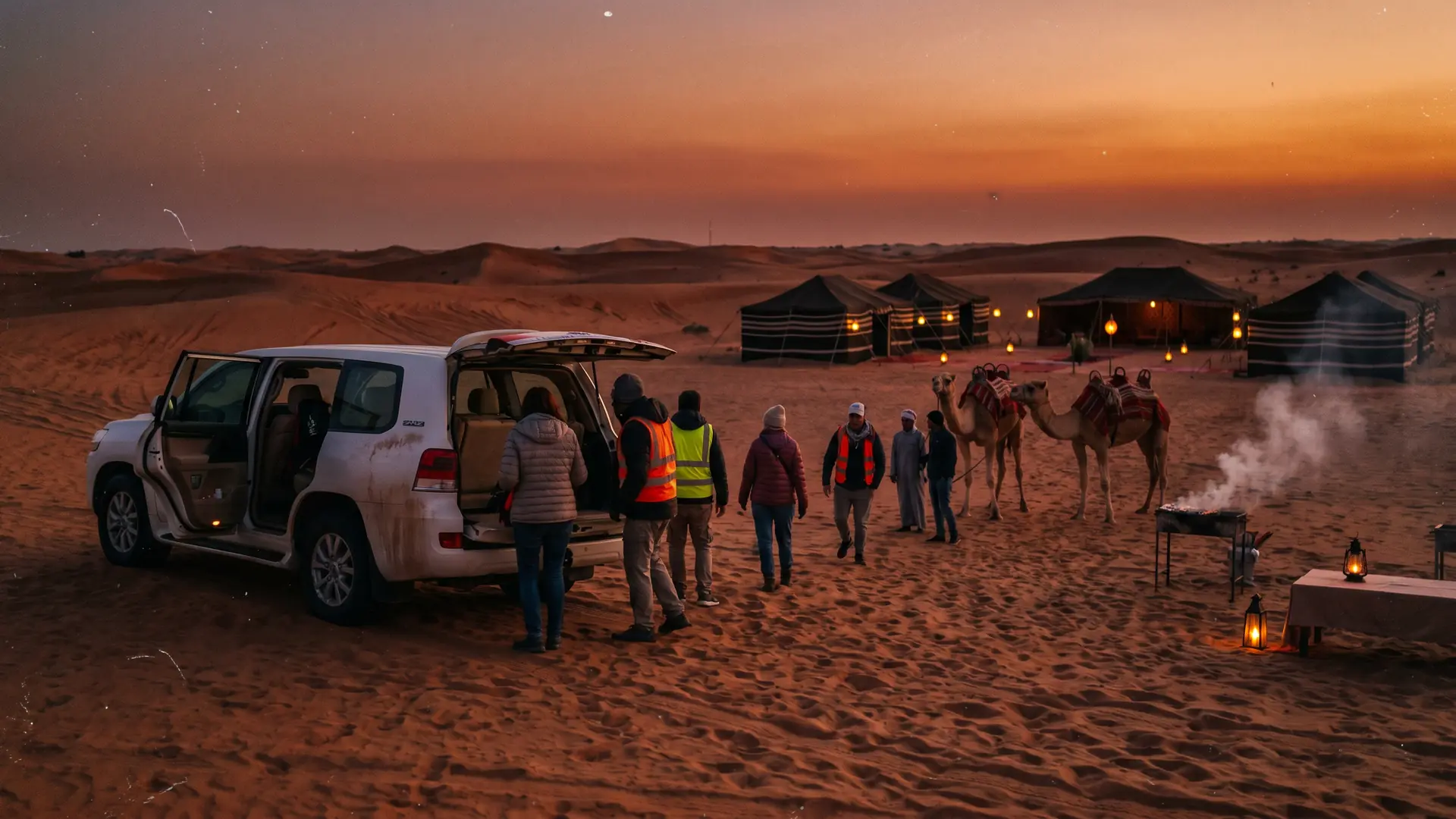
Dune bashing, a sunset stop, then the camp with a full halal BBQ and transfers handled both directions.
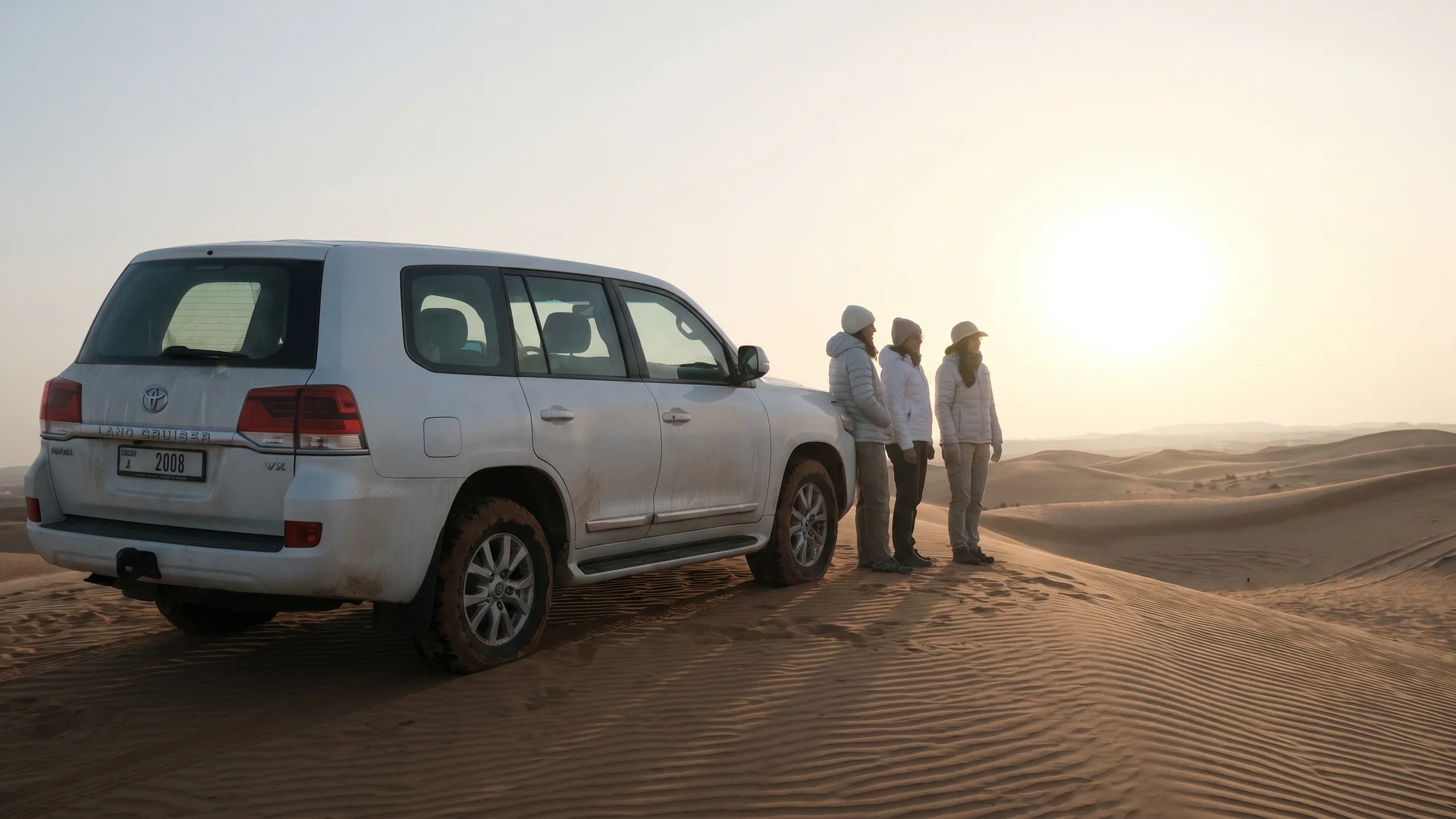
Your own 4x4 and your own guide, with no sharing a vehicle and no waiting on people you have never met.
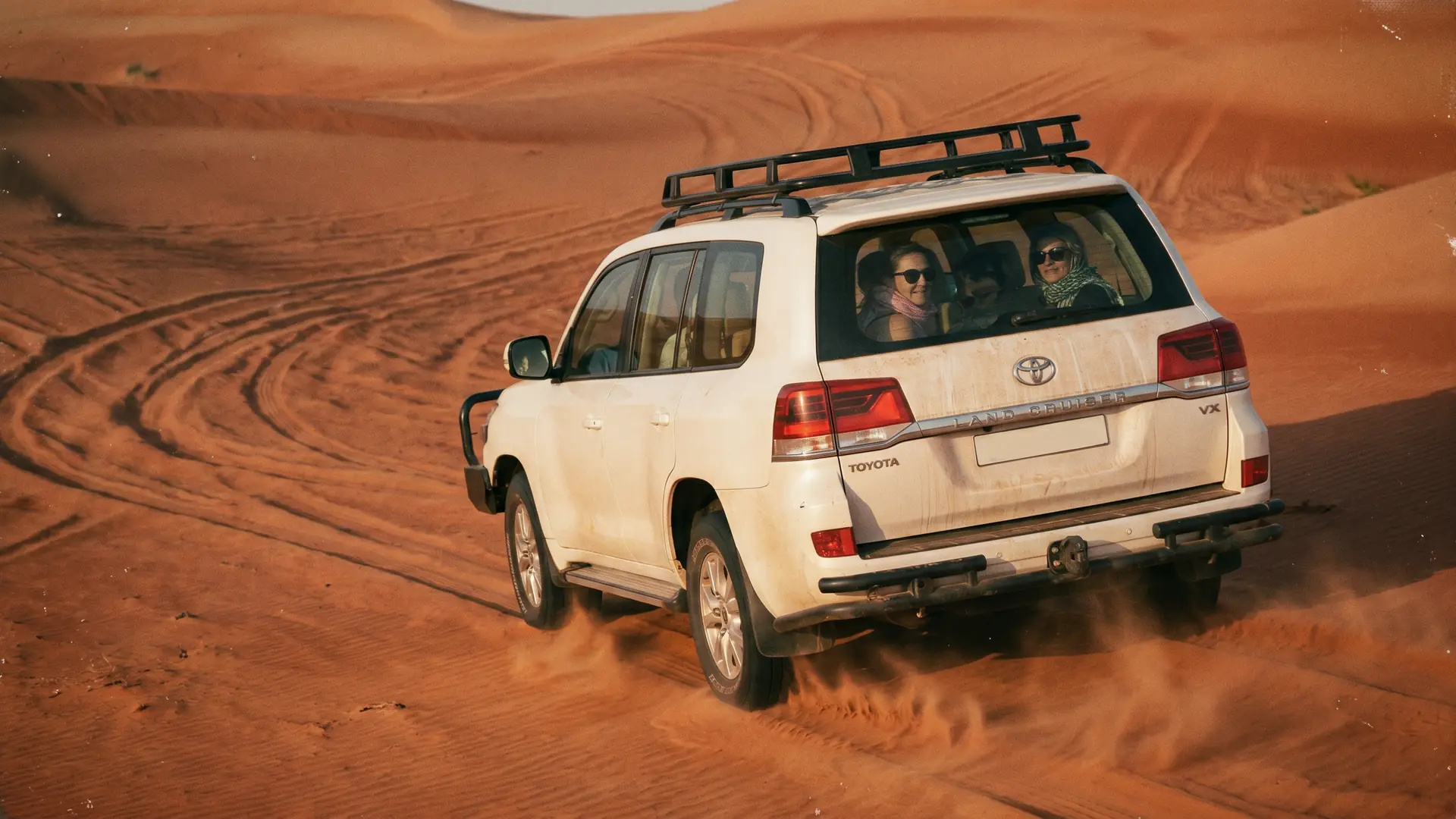
Your own driver, your own timing, and a table waiting at the camp reserved for nobody but your group.
Overnight desert camping, higher-end private setups, corporate days and family bookings all run outside this standard list, along with a calmer route for anyone who wants the desert without the dune bashing. Send the group size and the occasion on WhatsApp and a plan comes back the same day.
Sunrise flights over the desert, weather allowing. The flying window falls between September and May most years, and nothing else here answers to the weather quite the way this does.
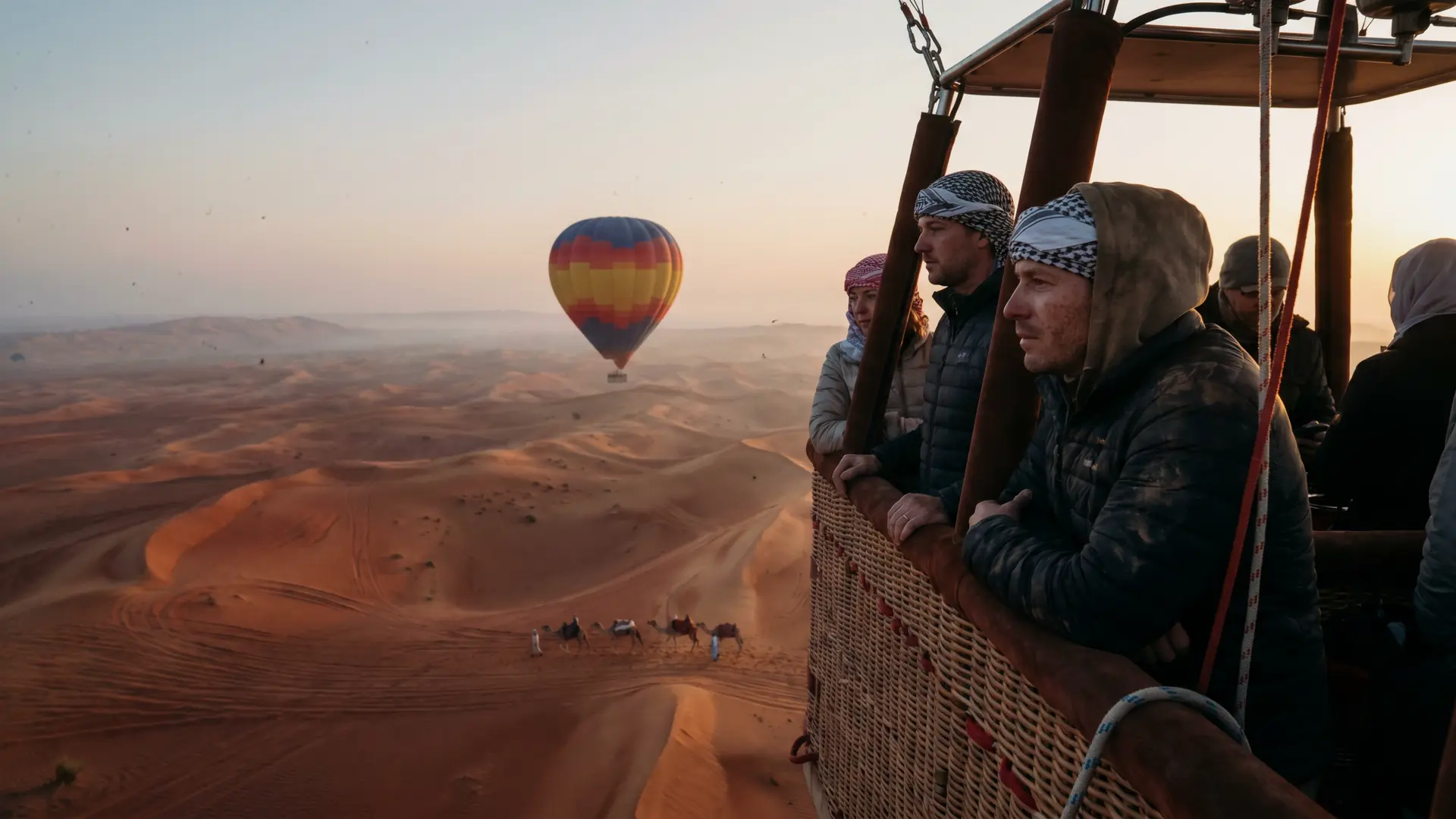
AED 1,049 for the standard flight. Falconry joins the trip at AED 1,149; a full breakfast afterward brings it to AED 1,349.
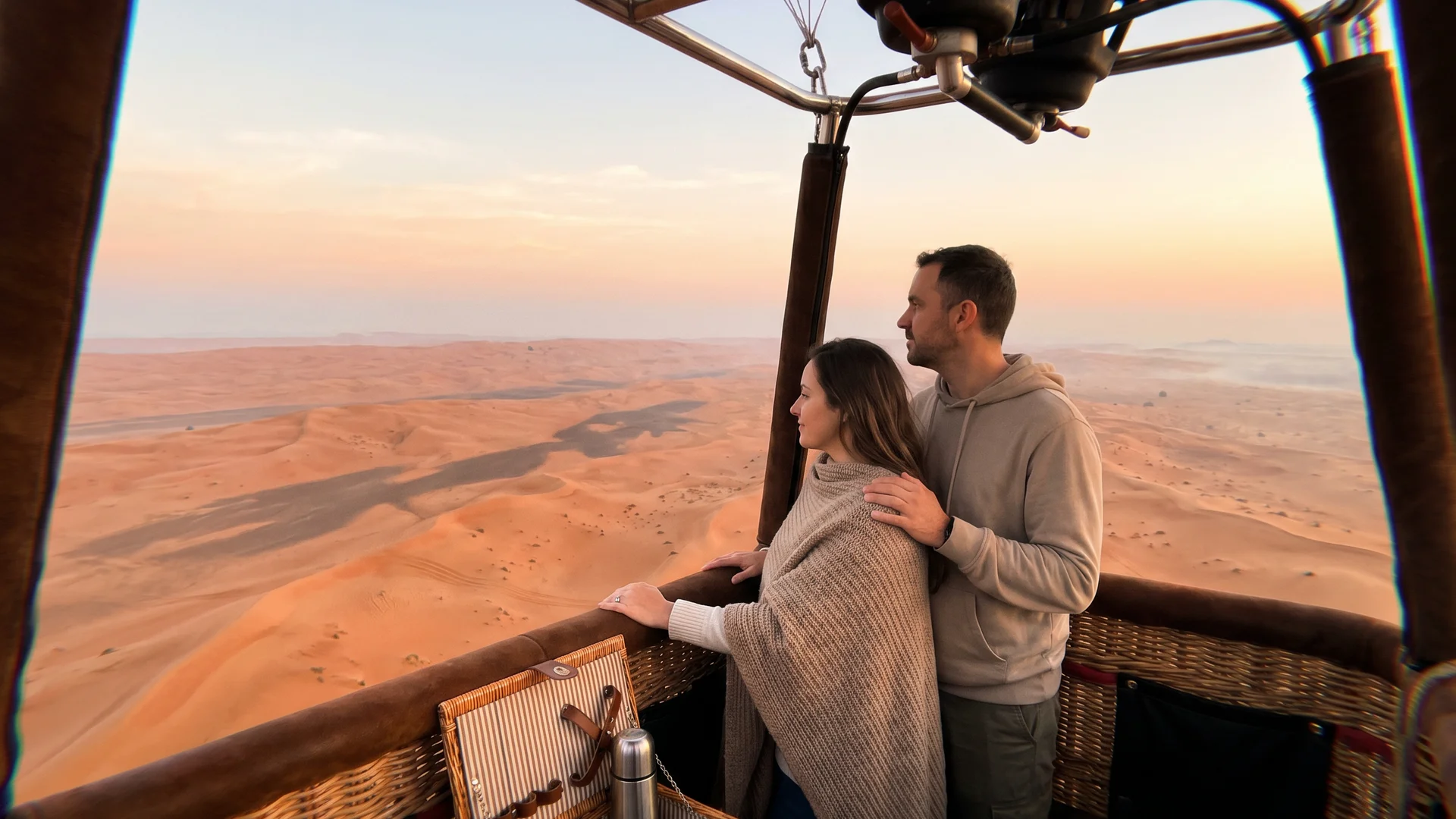
Just your party in the basket, nobody else. Usually booked for proposals, anniversaries and corporate mornings.
Small children, grandparents, or anyone whose nerve failed the moment they saw the Raptor up close. Same red dunes, a far gentler rhythm.
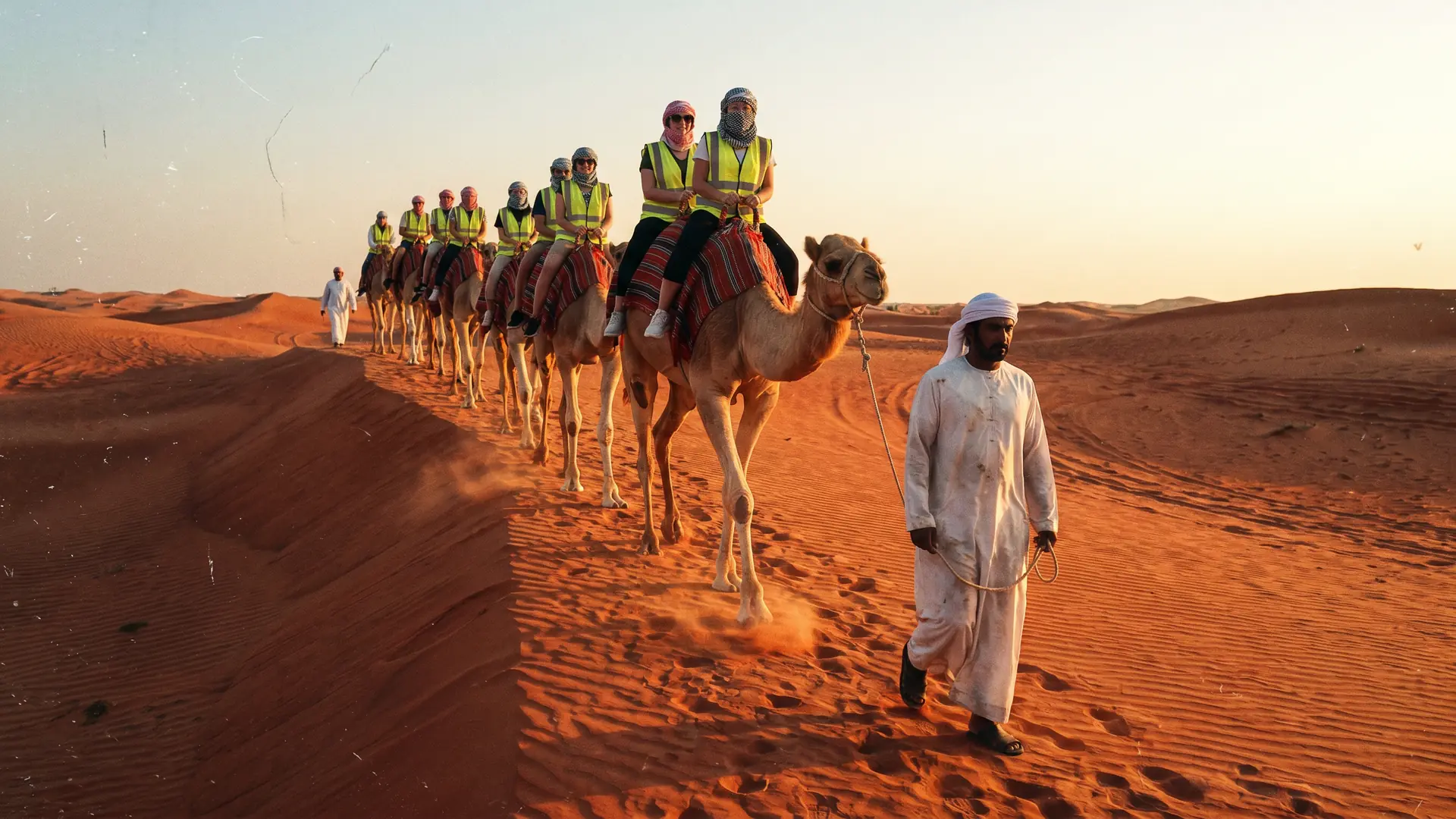
A guided walk over the same red sand the quads cross, just at a completely different pace. Open from age three with an adult.
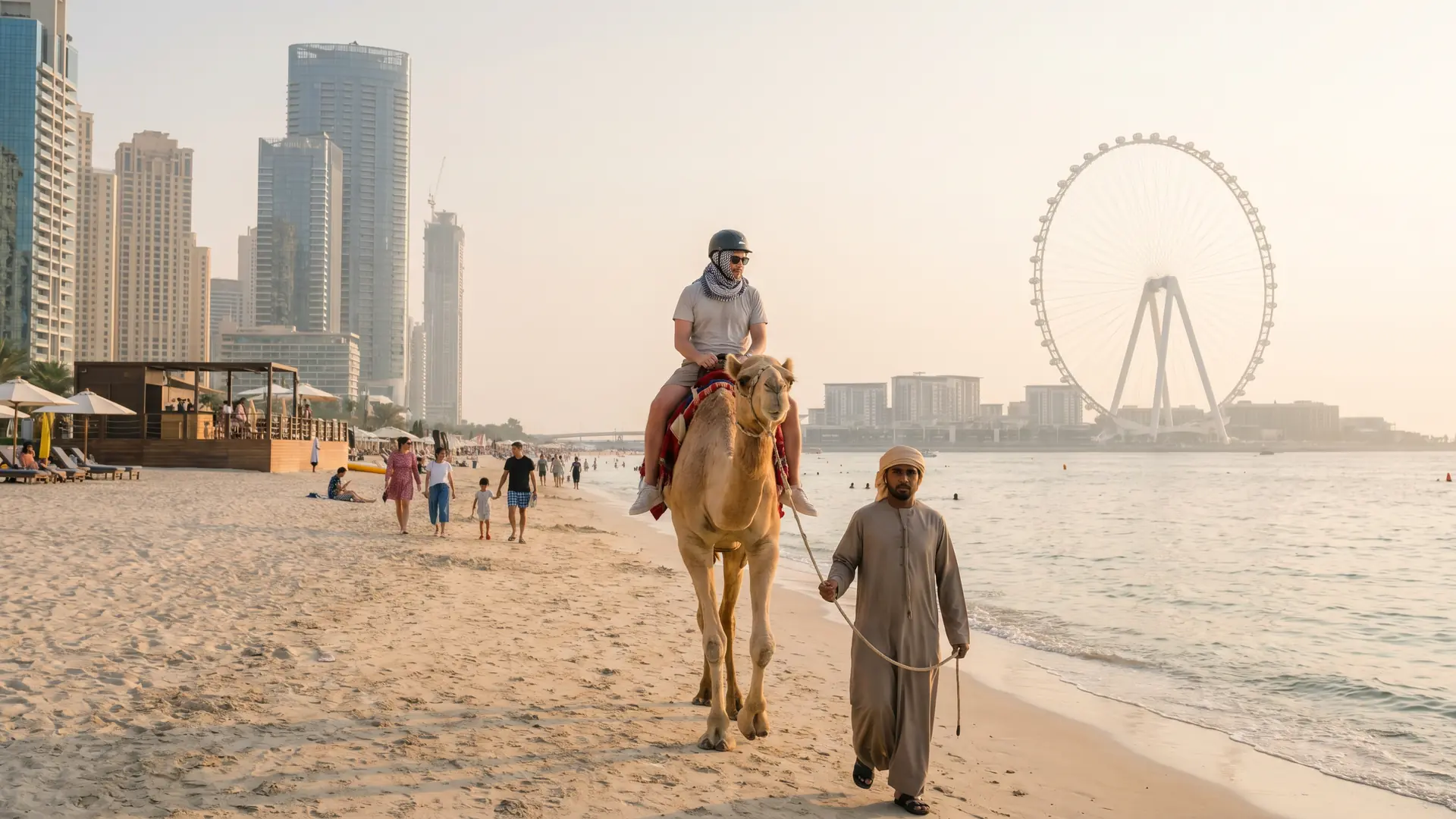
The sand at JBR, right inside the city limits, skyline filling the background of every photo you take.
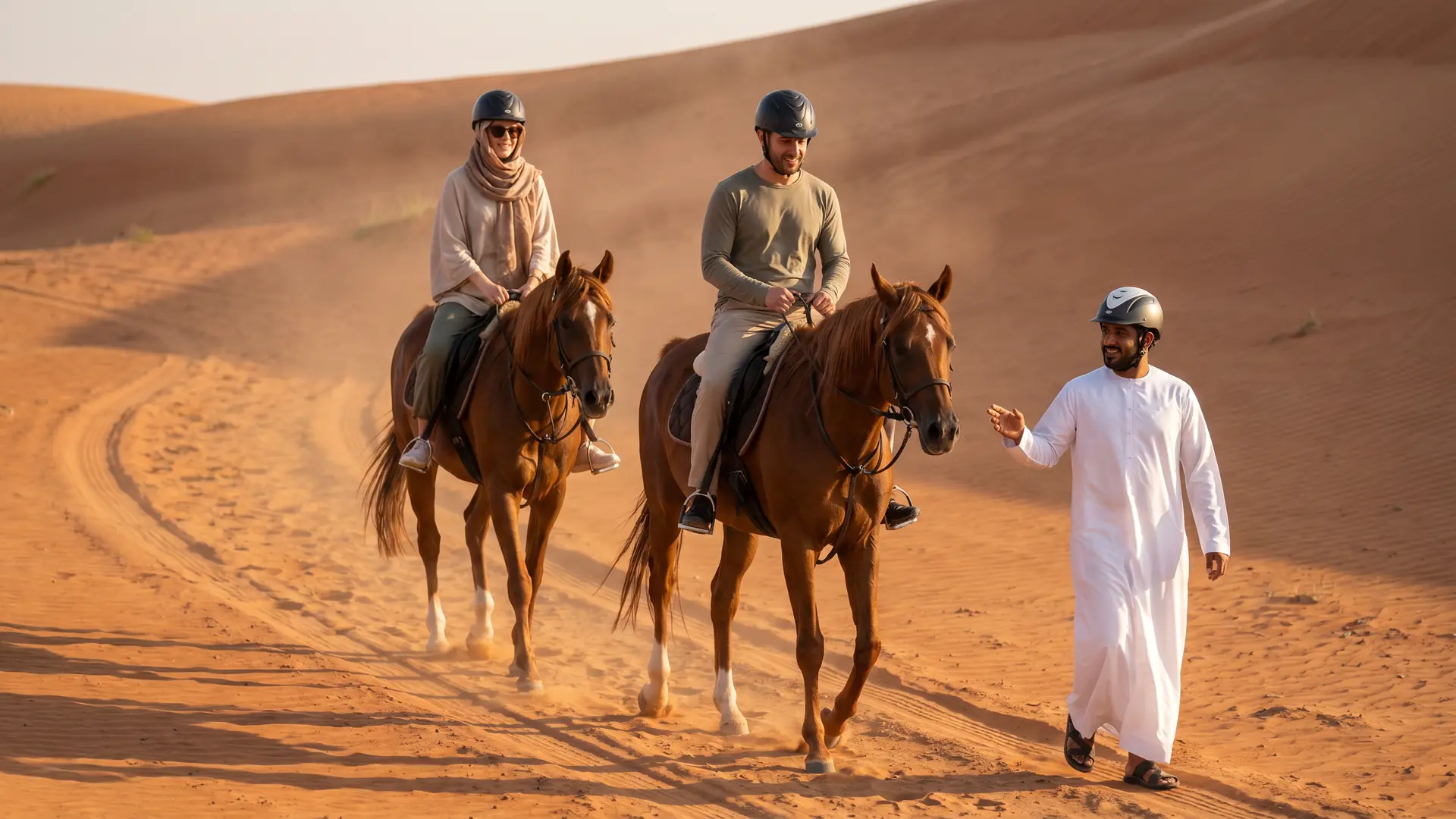
A guided trail across the dunes, best suited to anyone who already has hours in a saddle somewhere else.
These get quoted rather than priced up front, since headcount, machine preference and the length of time you want to spend out here all move the final number. Message the details across on WhatsApp and a number comes back within the day.
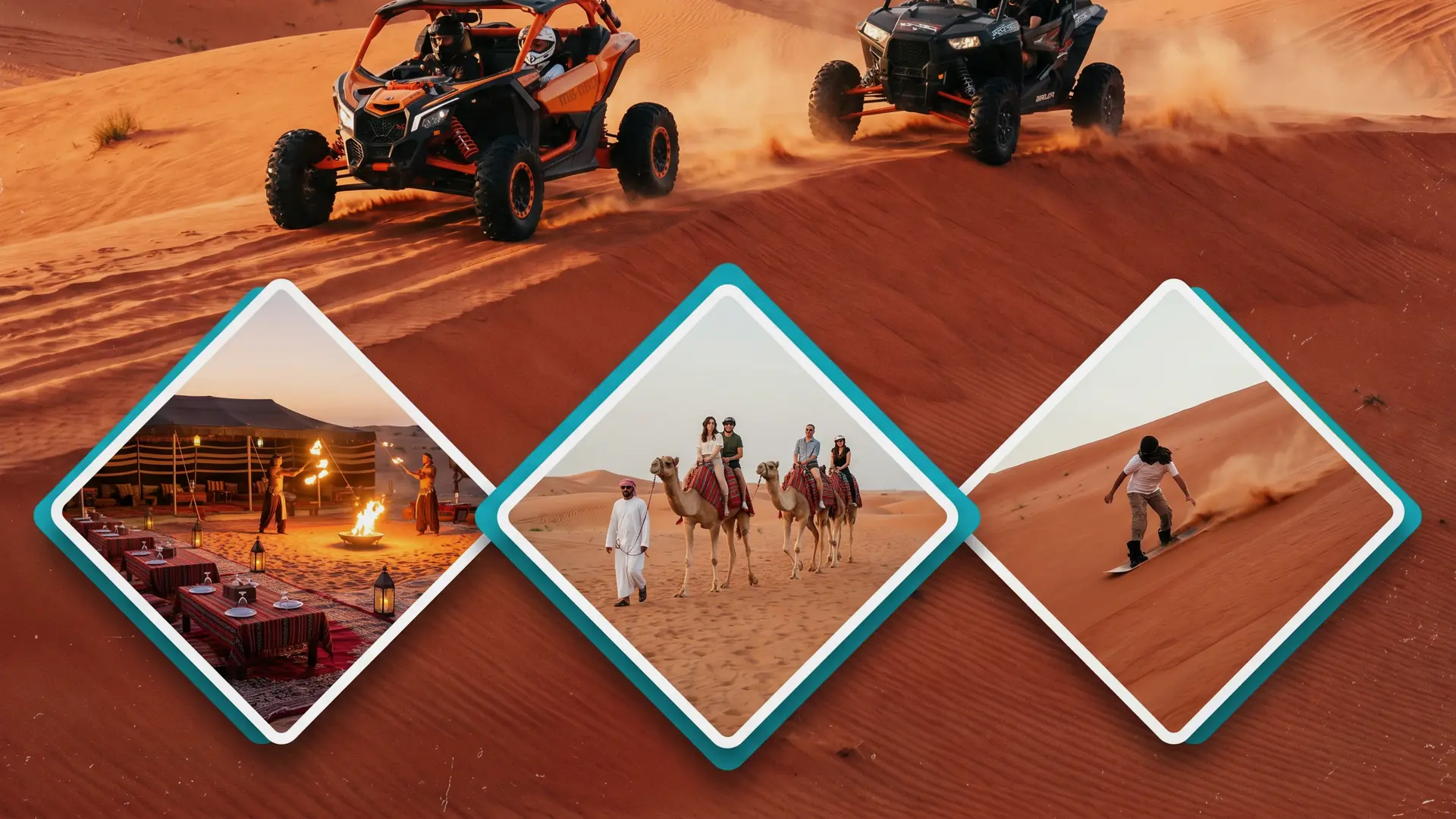
Quad first while everyone still has energy, buggy once arms are warm. Runs from about AED 290 up toward AED 1,100 once machines are chosen.
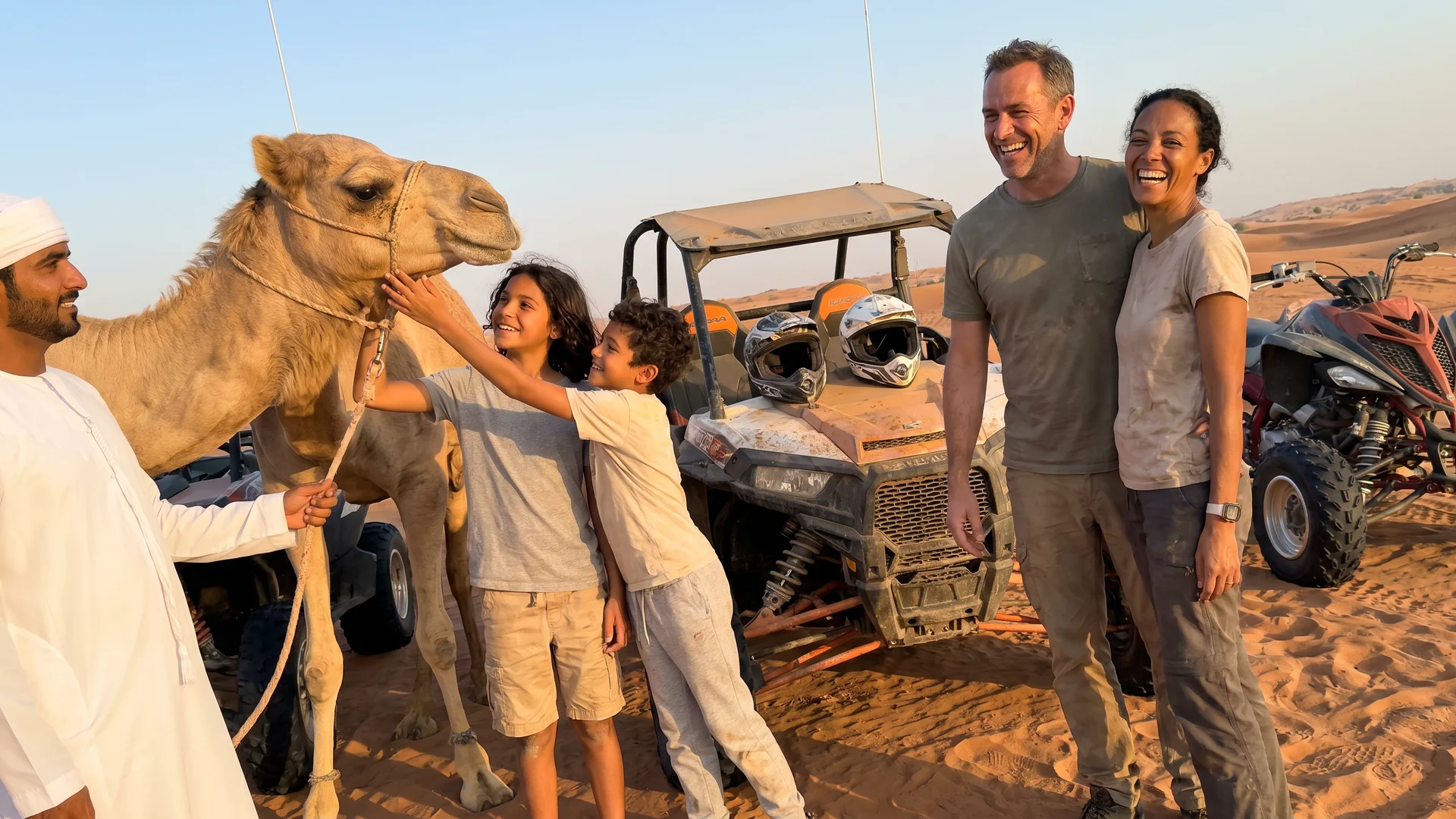
Three machines, one booking: a quad, a buggy and a camel, so every age bracket in the group has something to ride.
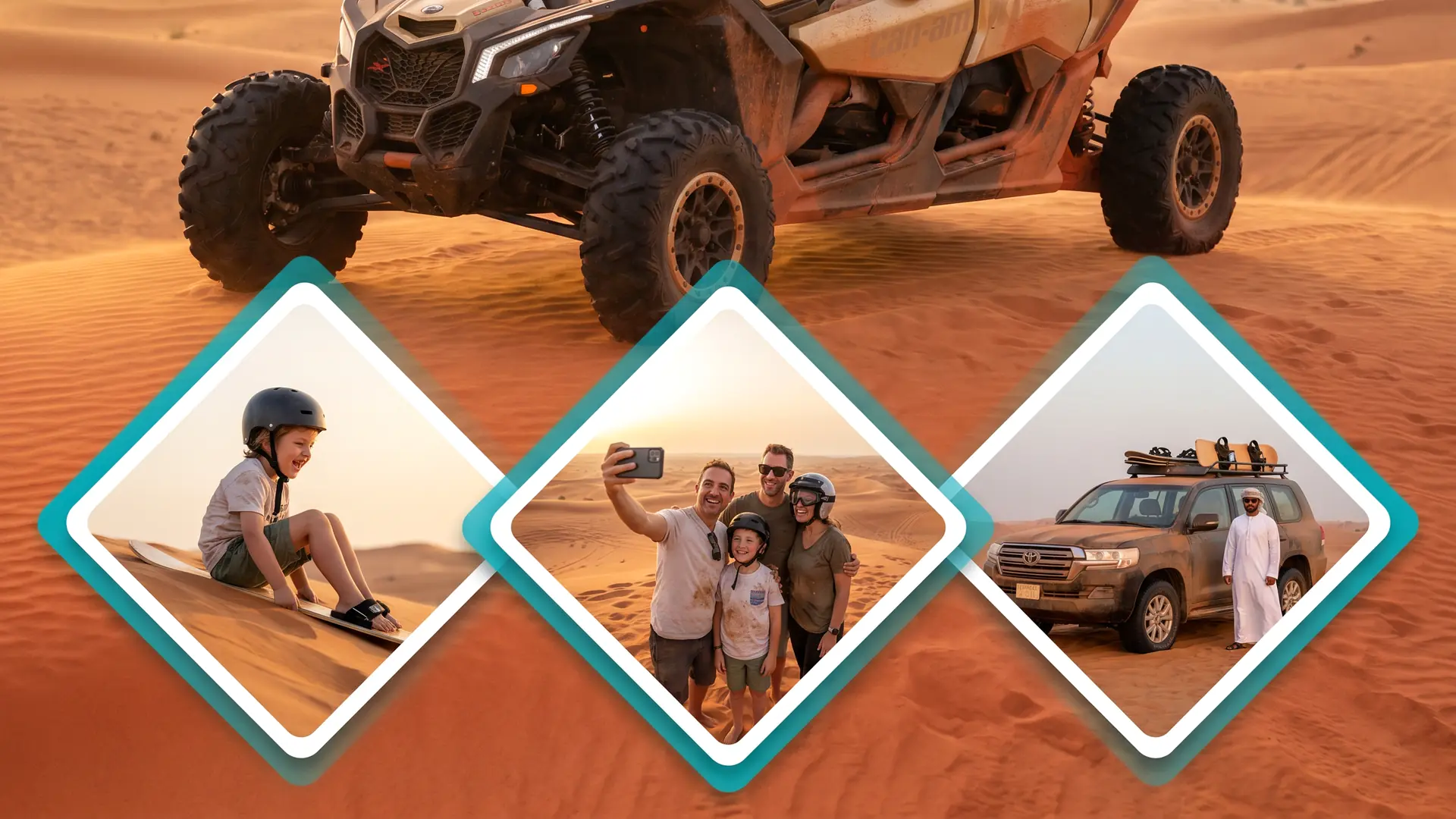
Every core activity folded into one day out — quad, buggy, safari and the BBQ camp. The total usually settles somewhere from AED 700 up to AED 2,200 depending on machines chosen.
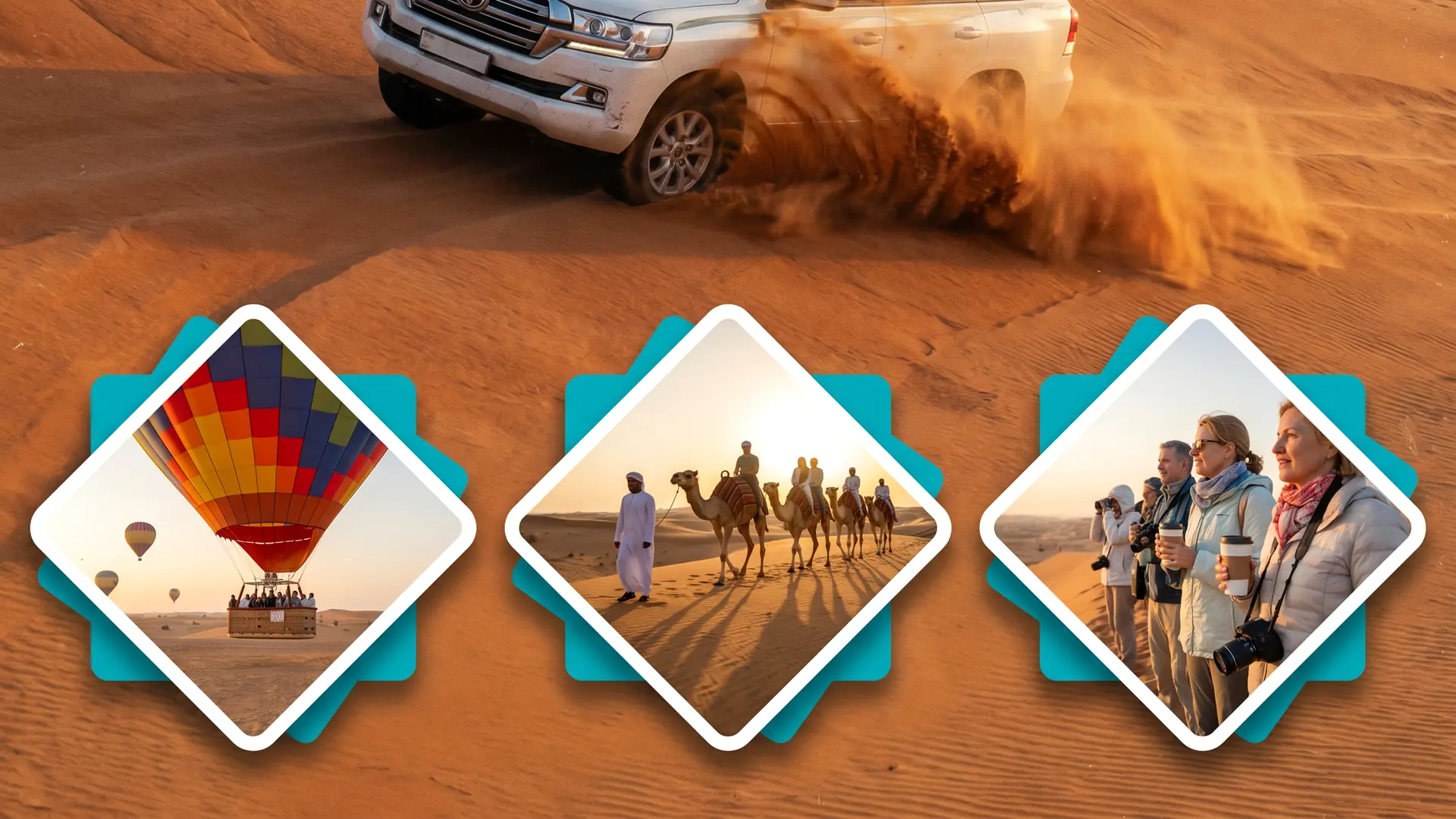
Up at dawn for the balloon, onto the dunes once the light has fully arrived. A long day that earns its length.
Every quad and buggy session sets off from the staging point at Al Lahbab, reached via the road toward Al Ain on the city's southeastern flank. What changes daily is the direction the guide leads you in from there — the sand itself is the deep iron red visible in every photo of this stretch of desert, shaped into steep-sided bowls and long ridgebacks, nothing like the shallow mounds you pass on the way out of town.
There is a flat run-up patch at the base where every session opens, whatever machine you are on. That five-minute stretch is where the guide reads your throttle control and decides not just how steep a face you get, but which line across the dunes the whole group follows that day.
The same six-part rhythm whether you booked the short slot or a full afternoon. It is only the middle section that stretches or shrinks.
Collected from central Dubai, or pointed to the meeting spot as soon as your booking is confirmed.
Throttle response, braking, body position and the stop signal all get covered once the helmet is fitted.
A short stretch of flat ground first, guide watching to see how you handle the throttle before today's line gets settled.
Behind the lead guide, through whichever bowls and ridges got chosen that day, with room built in for photo stops.
A breather, water, and a look through the photos the guide took, then it is transfer back to the city or straight into whatever combo you booked next.
For anyone on the evening package, the BBQ camp is the very next stop once the machines are parked.
Ages nine to twelve on the 90cc get their own supervised loop with a guardian present the entire time. Children younger than that cannot take a machine of their own, though a buggy seat with an adult driving or a camel ride from age three both work. If anything about your group is borderline, raise it on WhatsApp before you pay rather than saving it for the briefing itself. Dream Land Adventure Tourism holds the DTCM licence this operation runs under, and out in the dunes, the guide has final say over both route and pace.
Based on 1,462 Google reviews
Based on 588 reviews
The Yamaha 220cc is the cheapest adult option at AED 200, and the Raptor 700cc the priciest at AED 795, with the 400cc at AED 250 seeing more bookings than any other machine. Children between nine and twelve ride a 90cc on its own supervised loop for AED 150. Every rate covers one rider on one machine, except the AED 350 double, which seats two.
No licence needed. This runs on privately leased ground out at Al Lahbab, well outside the reach of any road authority. What actually gets checked is whether you can physically handle the machine, and the guide sees that firsthand once the warm-up starts, ahead of anything steep.
Nine years old for the supervised 90cc loop, with a guardian on site throughout. Below that age a child cannot take a machine solo, though a seat as a buggy passenger with a grown-up steering is fine, and the camel treks take children from age three.
The Yamaha 400cc double is the single machine on the fleet built for two, its extra seat covered by one combined AED 350 charge. Every other quad here takes one rider, full stop, and there is no doubling up on a solo machine.
At Al Lahbab, out toward Al Ain on the city's southeastern side, a good stretch southeast of Downtown by road. The riding surface is deep red sand, well away from the paler ground churned up by traffic nearer the highway.
No, it costs extra and gets confirmed before payment. Downtown, Marina, JBR, Business Bay and Deira are all handled without issue, and anyone driving themselves gets the meeting-point directions once the booking clears.
A quad suits you if you want a machine entirely to yourself and do not mind that your body weight does half the steering. A buggy suits you if a roll cage, a proper wheel and passenger seats sound better. Groups with mixed preferences frequently book a mix of both and swap who drives partway through.
Closed shoes, sunglasses, and clothes you would not mind losing to sand. Helmets are supplied. A face covering, whether a buff or a light scarf, does more for you out here than most people expect, and leaving a spare set of clothes in the car turns the ride home into something far less itchy.
The guide loops back and frees the machine, no drama attached — it counts as a normal part of how a session goes, not a mishap. More often than not it happens when a rider backs off the throttle too early on a soft climb. It costs nothing and rarely takes long.
Yes, so long as the 220cc ends up being your machine and you are upfront during the briefing. It is the flat-sand warm-up that does the real work here — the guide reads your handling and builds your route around it. Anyone who needs an easier line gets one quietly, with no fuss made of it.
The listed rate buys a standard session on the dune loop. A longer route, or a day that blends several activities, gets built directly with your group, and a combo folding in a safari or dinner can easily swallow most of an evening. Message your group size and dates for a proper timing plan.
Yes, and it is the direction most bookings go. Pair the evening safari with a quad session and BBQ and the total comes to AED 375, the single biggest seller on this site. Take that same combination in the morning instead and the figure comes down to AED 290. Want dinner with your quad but no 4x4 dune bashing at all — that band runs AED 700 up to AED 1,300, the spread coming entirely from which machine you ride.
Sandstorms and strong wind push a session to a new time instead of cancelling it outright, and you hear about the alternative slots well before your booked time arrives, at no extra cost. Quads shrug off marginal weather far more easily than the balloon flights manage.
Midweek, a few days' notice is usually enough. Weekend slots, Friday and Saturday specifically, want at least a week of lead time, longer again if the Raptor 700cc specifically or a large group of machines is what you are after. Secure online advance payment confirms your booking, support available 24/7.
A Dubai quad tour is not a fixed lap of the same dune every time. The lead guide reads that morning's wind, how firm or soft the sand has settled, and the group's skill level, then chooses which bowls and ridgelines the session actually crosses. Adult machines range from AED 200 up to AED 795, per rider, with the 400cc at AED 250 the most common choice, and children nine to twelve ride a supervised 90cc loop at AED 150. Same operator, four more activities on the same red sand: buggies start at AED 599, KTM dirt bikes at AED 850, Land Cruiser safaris at AED 225, sunrise balloon flights at AED 1,049, and camel treks at AED 150.
The package most people end up booking pairs a Land Cruiser safari with your quad session and a BBQ dinner, all for AED 375: dune bashing, a ride on that day's chosen route, and food at the camp, all part of the same evening. Secure online advance payment confirms your booking, support available 24/7.
A quad session on the day's chosen route, dune bashing beforehand, then the camp.
AED 375Rides the same terrain, just with a gentler line picked for it.
AED 200Handles whatever bowls and ridges the guide leads that day.
AED 250Gets the technical stretches the entry machines are steered around.
AED 795Its own closed track, kept apart from the main route entirely.
AED 150Firmer sand and often a different line than the evening group rides.
AED 290A different way entirely to see the same dune country from above.
AED 1,049Your own vehicle and pace, with no group route to keep up with.
AED 1,400It changes. There is no single worn-in loop that every group rides regardless of conditions. The guide reads that morning's wind, how the sand has settled overnight, and who is in the group, then picks a fresh line through the dunes from a wider stretch of terrain the operator has access to.
It helps to separate two things that get confused: the base is fixed, the route is not. Every session still begins at the same staging point at Al Lahbab, on the same patch of flat sand used for the warm-up. What is not fixed is which direction the group heads once that warm-up is done. Two groups leaving that same flat patch an hour apart can easily end up riding two different stretches of dune, and neither one is the "default" version.
The reason for that is mostly physical. Wind reshapes loose sand overnight, so a crest that rode firm and predictable yesterday can be softer or steeper today, and a bowl that got ridden hard by an earlier group is left chopped up and rutted rather than clean. A guide who rode a route on Tuesday has no particular reason to send Wednesday's group down the exact same line, and every reason not to if that line has since gone soft or worn.
This is also just a more honest way to run the activity than a fixed circuit would be. A single loop ridden by every group, every session, every day, wears a groove into the sand fast — the surface gets pushed around, edges blow out, and what was a clean bowl in month one becomes a rutted mess by month six. Spreading sessions across a wider area, and choosing direction fresh each time, is as much about keeping the terrain rideable as it is about keeping it interesting. The full pickup-to-drop-off sequence, including where the warm-up sits in that order, is covered in how a session runs.
A typical session opens on the flat run-up patch at the base, then moves into a mix of shallow bowls, a few steeper faces, and ridge crests linking one bowl to the next. How far into the steeper ground you go depends on the machine you are on and how the warm-up went.
Think of the terrain in layers rather than one continuous climb. The session starts flat, on firm compacted sand where the guide can watch how you handle the throttle without any real consequence for getting it wrong. From there, most routes drop into a bowl — a wide, saucer-shaped depression scooped out by wind, with a gentle enough gradient that it works as a warm confidence-builder before anything sharper. Bowls are where a lot of the actual riding time gets spent, looping the inside face and building rhythm.
Between bowls sit the ridge crests, the narrower spine of sand connecting one depression to the next. These are shorter sections but a noticeably different feel underneath you: the sand is looser up on a crest, blown thinner by wind, and the machine wants to wander more than it does down in a bowl. Guides usually take crest crossings at a slower, more deliberate pace for exactly that reason. Beyond the crests are the steeper faces, the closest thing to a genuine climb on the route, where torque and body position both start to matter.
A full session usually links together three to five of these features rather than one long uninterrupted push — flat ground, a bowl or two, a crest crossing, maybe a proper face, then a flatter stretch to regroup before the next section. Which machine you are on changes how deep into that last category you get taken, something covered properly among the eight machines on the fleet.
Three things: which way the wind has been blowing, since that reshapes the soft crests; how fresh or chopped-up a given bowl is from recent sessions; and how the group performed in the warm-up. All three get read before anyone leaves the flat ground.
Wind is the first input, and it is a bigger factor than most first-time riders would guess. A few days of steady wind from one direction builds a firmer, more compact face on the sheltered side of a dune and leaves the exposed side loose and unpredictable. A guide who has been out on the sand recently already has a rough sense of which faces are currently holding their shape and which ones are due to be soft, and that reading feeds straight into which way the group turns off the flat ground.
The second input is closer to land management than weather. Bowls and faces that get ridden hard on back-to-back sessions start to rut and lose their clean line, and a guide who keeps sending groups over the same worn ground is making the next session worse for everyone, including future bookings. Spreading direction across a wider sector, letting a heavily used bowl sit for a session or two while the wind has a chance to reset it, is a deliberate part of how the route gets chosen, not an accident.
The third input is the one every rider actually notices: the warm-up. A guide watching a nervous first-timer circle the flat ground is not going to point that group at the steepest sector available that day, no matter how good the sand is riding. A group that looks composed and confident earns a more direct, technical line. Mixed-ability groups tend to get a route with an easier core line and a couple of optional steeper spurs the stronger riders can peel into and back out of, so nobody is stuck riding either far above or far below their comfort level. The same read that sets your route also decides which quad you should be on in the first place.
Yes. Most routes include two or three natural pause points — a high ridge crest for a wider view, a broad bowl floor for regrouping, and often a run past one of Al Lahbab's more distinctly red faces. Exactly which points depend on that day's direction.
Stops are not just there for photographs, though the photographs are a genuine reason on their own. A guide halts the group for a headcount, to let slower riders close the gap, and sometimes to talk through what the next section of terrain is going to ask of the machines before everyone commits to it. A route with zero stops from start to finish would actually be a worse-run session, not a more efficient one.
The stops themselves tend to fall into a small set of natural types rather than being picked at random. A high crest, somewhere the ground opens up and on a clear day you can pick out the city skyline sitting hazily on the horizon, works well as a pause because it is wide enough for the whole group to sit side by side. A broad, flat bowl floor does the same job lower down, and doubles as the regroup point before or after a steeper section. And because Al Lahbab's sand runs an especially deep red in places, guides know which faces catch the light best and will often route past one specifically for the photo, whatever else that day's line looks like.
Because the wider route shifts session to session, the exact GPS point of any given stop shifts with it — there is no single "the viewpoint" that every group visits. What stays consistent is the type of place a guide chooses to pause: a high point, a regroup bowl, a strong stretch of red sand. The guides shooting photos along the way and sending them over afterward, mentioned in where we ride, happens at exactly these points.
Al Lahbab is a large stretch of open desert used by more than one licensed operator, so a route can occasionally pass within sight of another group. It is not a private, fenced concession, but sessions are timed and directed so that separate groups are not sharing the same line at the same moment.
It is worth being straightforward about this rather than pretending otherwise: nobody holds exclusive rights to the whole of Al Lahbab. It is a genuinely large area of red dune country, and several DTCM-licensed operators run sessions across different parts of it, sometimes within view of each other from a high crest. Anyone expecting a fully private stretch of desert with nobody else in sight the entire session should book a private safari instead, where that is part of what you are paying for.
In practice this matters far less than it sounds. Guides working the same general area are managing their own groups' timing and direction, and a session is built to avoid two groups converging on the same bowl at the same moment rather than queuing behind each other. Spotting another set of machines in the distance on a ridge is occasional, not constant, and it does not change how your own group is spaced, briefed or led.
What actually governs your experience is not whether the land is exclusive, it is how your own session is run once you are on it: spacing between your group's machines, a guide who sets the pace and calls the stops, and a warm-up that decides your route before anything steep starts. Those details are covered fully in safety and suitability, and they apply the same way whether or not another operator happens to be working the far side of the same stretch of desert that day.
Same general area, different depth. A 220cc rider who has just come off the warm-up gets steered toward the gentler bowls and moderate faces; a Raptor 700cc rider who clears the same warm-up gets taken further into the steeper climbs and tighter ridge work the smaller machines are kept away from.
It is not that a beginner and an advanced rider are on two unrelated routes. Both groups are out on the same stretch of Al Lahbab, crossing the same kind of bowls, crests and faces described earlier in this guide. What changes is depth: how far into the steepest, loosest, most technical end of that terrain the guide is willing to take a given rider, based on what the machine and the warm-up have already shown.
The eight machines on the fleet roughly map onto that depth. The 220cc and the standard 400cc cover the core of most routes comfortably — the bowls, the moderate faces, the gentler crest crossings. The Grizzly 450cc, being heavier and more planted, gets used for routes that run longer over rougher ground rather than for extra steepness as such. The sports 625cc and the Raptor 700cc are the two machines actually built to be pushed into the tightest ridge work and the steepest sustained climbs, and they are also the two that require a short conversation with the guide before you take the keys, precisely because that terrain punishes a bad line far more than the entry sections do.
None of this makes the entry-level version a lesser experience. A 220cc rider still crosses bowls, still rides a crest or two, still gets a proper look at the red dune country this guide has been describing throughout — the steepest faces are simply not part of that particular day's line for that particular rider. Riders who want to test that boundary properly are better off working up through the machines across a couple of visits than pushing for the Raptor on day one; the honest breakdown of which machine suits which rider sits in the rate table above.
Often, yes. Morning sand is firmer after the overnight cool-down, which opens up faces that feel greasy and unpredictable by the time the afternoon heat has worked on them. Evening routes lean toward a line that finishes facing west, timed so the last stretch rides into the changing light rather than away from it.
Sand behaves differently depending on how much sun and heat it has absorbed, and that genuinely changes what a guide is comfortable including in a route. Overnight, the sand cools and settles, and a morning session rides across ground that grips more predictably under a tyre than the same face will by mid-afternoon, once hours of heat have loosened it back up. A steeper climb that feels solid and confidence-building at eight in the morning can feel noticeably softer and more demanding ridden again at four in the afternoon on the same machine.
Evening sessions get chosen with a second factor layered on top of the sand itself: direction relative to the sun. A guide building a late-afternoon or evening route will often favour a line that ends up facing west, so the final stretch rides into the changing light rather than with the sun at your back the whole way, and so any stop points land somewhere with a clear view of the sky doing its thing. That explains a good share of why the evening safari, quad and BBQ combo sells the way it does — the route itself is built around that last hour of light, not just the dinner at the end of it.
None of this is only about scheduling around the heat, which is covered separately in quad plus safari and BBQ. It is specifically about which physical line through the dunes makes sense at a given hour, given how the sand is behaving and where the sun happens to be. Book the same package twice, once in the morning and once for sunset, and do not be surprised if the actual dunes underneath you are not quite the same ones either time.
Yes, everyone in a session travels behind the same lead guide on the same chosen route. Riders are not sent off on individual paths; spacing between machines is the only thing that varies rider to rider.
You can ask, and a guide will factor it in where conditions and group safety allow, but the final call on direction stays with the guide on the day. A named dune or a specific photo spot cannot be guaranteed in advance.
A standard session covers the base route in roughly the time booked, whether that is the shortest slot or a longer combo package. Distance is not fixed to a set number of kilometres, it is paced to time and terrain instead.
Rarely exactly. Wind, recent traffic and the day's group all shift the direction, so a second visit usually rides a noticeably different stretch of the same wider area even if the two bookings sit back to back.
No permanent markers. The lead guide is effectively the route, and the group follows the machine in front rather than any fixed trail signage laid out across the open sand.
The guide sets spacing deliberately and checks the group at each stop point before continuing, so a strung-out line gets regathered rather than left to sort itself out on its own.
Rain is rare here, but when it happens the sand firms up in a way that opens some faces and closes others, and the guide adjusts that day's line accordingly rather than riding a fixed plan regardless of conditions.
No. Even Raptor 700cc riders on the technical end of the route stay with the group line; peeling off independently to explore is not permitted regardless of experience.
Planned, broadly. The guide already has a rough sense of where the good vantage points sit on that day's line and works a stop or two into the route rather than deciding on the spot.
Often yes, since a buggy's wider footprint and different ground clearance suit slightly different terrain than a quad, so the two machines are not always sent along an identical line even when booked together.
Pick the machine you want, secure it with online payment, and pickup timing gets settled on WhatsApp the day before departure.